

By Aura Nabila Adriya Putri and Amalia Khoridatul Fadila, Third-Semester Students of the English Education Program.
For many university students, learning English happens inside the classroom. For us, however, a recent experience gave us the opportunity to step outside the classroom and use English in a real international environment. What began as an unexpected opportunity became one of the most memorable experiences of our university journey.
On August 13, 2026, Super Garuda Shield, a joint military training activity involving personnel from 12 countries, took place in Martapura, South Sumatra, Indonesia. The activity continued for almost two months and officially ended on September 25, 2026, with various training programs and activities involving military personnel from different countries.
Honestly, we had never imagined that we would become part of an international event on such a large scale. However, our lecturer gave us the opportunity to participate as translators. At first, we were surprised and a little nervous. Then we thought, Why not? An opportunity like this might not come twice. So, we decided to take the chance, use the English skills we had learned, and learn as much as possible along the way.
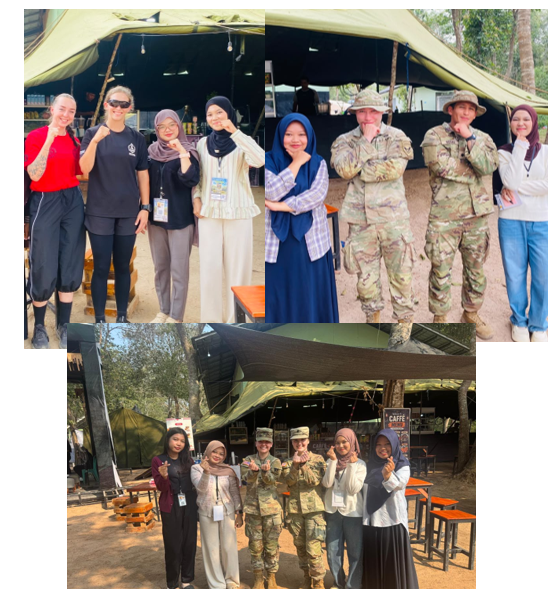
We left home on August 25, 2026, and immediately began our work. Puslatpur Martapura felt very different from the environments we were used to. The area looked more like a large forest, with brown military tents, barracks, military vehicles, tanks, equipment, and various activities taking place throughout the area.
In one part of the location, there was a food stand where we were assigned to work. It was from this simple place that our unforgettable experience began.
At first, we felt nervous and a little awkward. We knew that we would meet people from different countries and communicate with them directly in English. However, as we became more familiar with the environment, our nervousness slowly turned into curiosity and excitement.
As translators, our main responsibility was to help facilitate communication between international soldiers and the Indonesian staff at the food stand where we worked.
When the soldiers came to look at the food, buy snacks, drinks, fast food, ice, or other items, we welcomed them and asked what they would like. We also helped explain and recommend the available menus, ranging from Indonesian food to Western food.
When they came to look at the food, buy snacks, drinks, fast food, ice, or other items, we welcomed them and asked what they would like to have. We also helped explain and recommend the available menus, from Indonesian food to Western food.
While waiting for their orders, we often introduced ourselves and had conversations with them. At first, we thought our role would mainly involve translating. However, we soon realized that we were getting something much more valuable: the opportunity to communicate directly with people from different countries and use English in real-life situations.
So, besides being translators, we were also training our confidence, courage, communication skills, and willingness to step outside our comfort zones. And honestly, we had a lot of fun doing it.
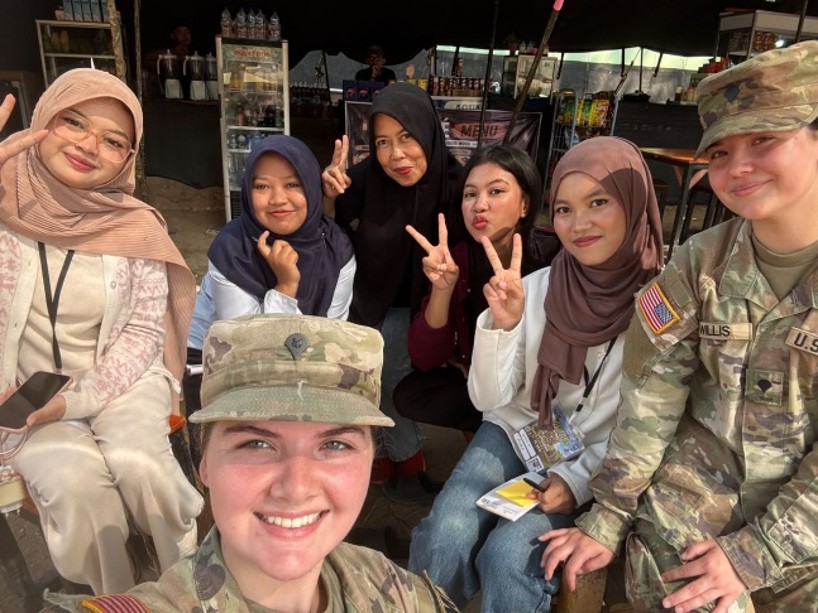
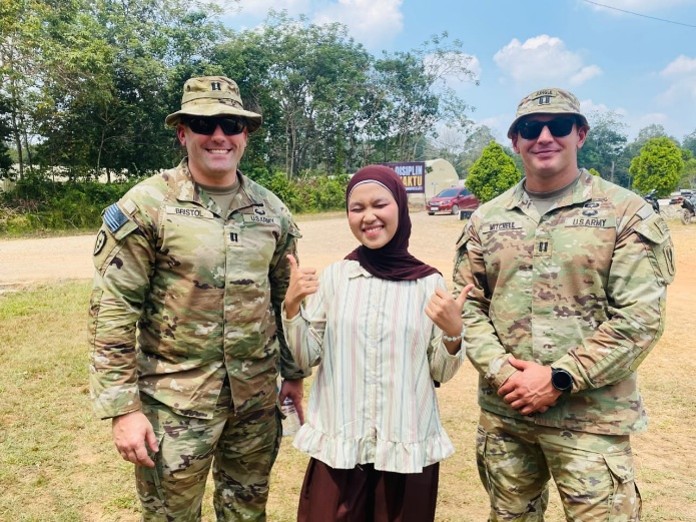
During our time there, we met military personnel from several countries, including the United States, Australia, New Zealand, Japan, India, China, Spain, and Indonesia. They came from different teams and backgrounds, giving us the opportunity to interact with people with different experiences and perspectives.
Most of the people we interacted with were from the United States. Some told us that they came from Alaska, California, Samoa, Alabama, Chicago, Michigan, Hawaii, Texas, and many other places.
Before this experience, when we heard the name of a country, we usually imagined it simply as a country. We did not know much about the different states, cities, or regions within the United States. At Puslatpur, however, we had the opportunity to meet people from some of those places and hear stories about where they came from and what their lives were like.
We also realized that every person had a different way of speaking. Their accents, rhythm, intonation, vocabulary, and even the way they carried on a conversation could be different. Each conversation became a new learning experience for us.
During the activity, we did not simply translate English into Indonesian. Most of the time, we used English to communicate directly with the international participants. We were not only speaking English to translate something for someone else; we were also using the language to develop our own speaking and communication skills.
English became our common language, even though some participants did not use English as their first language, including participants from Japan, China, and India. Sometimes, they also found it difficult to express themselves in English. When communication became challenging, we used translation applications to help us understand one another.
Those moments, however, became part of our learning process. We paid attention to the way people spoke, including their pronunciation, rhythm, intonation, slang, and use of formal and informal language.
Hearing English directly from people who use it in their daily lives felt very different from learning English in a classroom. We realized that our speaking skills still had a lot of room for improvement.
At the same time, we felt grateful because the English knowledge we had been learning could finally be used in a real international setting.
Of course, we were nervous and sometimes felt awkward at first. There were moments when our minds seemed to stop working. We forgot vocabulary, mispronounced words, or suddenly struggled with grammar.
However, we learned that making mistakes was a normal part of communication. Whenever we forgot a word or suddenly lost track of a sentence, we took a breath, spoke more slowly, explained the main point, and tried to find another way to express what we meant.
Gradually, we became more comfortable. Speaking with the participants began to feel like talking to friends. They were welcoming and friendly, which made us less afraid of making mistakes.
Some of them even complimented our English. When they found out that we were university students majoring in English, they became interested in our studies. They also shared encouraging messages about how English could open opportunities to see the world, meet new people, and experience different cultures.
For us, those words became one of the most meaningful parts of the experience.
Through this opportunity, we learned that language skills are not developed only through grammar, tenses, and vocabulary learned in the classroom. They also need to be practiced through real communication and meaningful interaction.
We improved not only our speaking and listening skills, but also our vocabulary, pronunciation, confidence, communication, self-control, professionalism, discipline, courage, and adaptability.
Most importantly, we learned that we do not have to wait until we feel “good enough” before we start speaking English. We improve by trying, making mistakes, correcting ourselves, and trying again.
We know that our English is still far from perfect. However, this experience gave us greater confidence and motivation to continue learning.
Today, we are happy to share this experience with the public—not simply as a story about translating at an international military training event, but as a story about two university students who were given a chance to step outside the classroom, meet people from different countries, and discover that the English they had learned could truly connect them with the world.
We are grateful to our lecturer for giving us this opportunity and to everyone who welcomed, supported, and trusted us during the activity.
This experience taught us one simple but meaningful lesson: learning has no limit. We can learn anytime, anywhere, and from anyone.
And for us, Super Garuda Shield 2026 will always be remembered as the moment when the English we learned in the classroom came alive in the real world.